Multi-Agent Influence in Social Navigation: Understanding Emotion and Group Dynamics

Abstract
Promoting sustainable behaviors is challenging because sustainability feels distant from people’s immediate goals and social connections. Being sustainable often comes down to what we perceive others are doing, whether we should recycle because all our neighbors do. Serious games show promise in raising sustainability awareness, but they overlook how social influence may shape behavior. We developed a game engaging players in dialogues with six characters on a mission to determine what infrastructure to develop in a rebuilding city. Participants in between-group study (N=60) played in scenarios of 5:1 pro-sustainable vs pro-economic opinion characters (sustainable-majority), 1:5 (economic-majority), or 3:3 (balanced-opinion) conditions. Results showed that players in the 5:1 condition made more sustainable in-game choices than those in 1:5 or 3:3. Players in 5:1 also showed increased intention towards sustainable behaviors post-game-play compared to two-weeks pre-game-play. Our work provides a blueprint for the design of playful social strategies for encouraging pro-social actions.
Project Overview
This project investigates how emotional expressions shape group behavior and individual decision-making in multi-agent social navigation tasks. By simulating collaborative and conflict scenarios in virtual environments, we analyzed the mechanisms through which emotions mediate group interactions and uncovered how affective signals influence social dynamics and collective outcomes.

Methodology
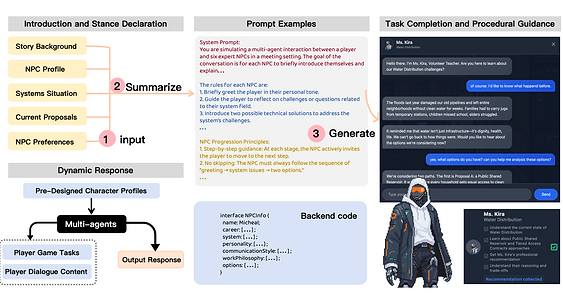
To explore how group attitudes influence sustainability-related decision-making, we designed the game EarthSeed, set in the year 3100 when humanity attempts to return to Earth after ecological collapse. Players, acting as leaders of a reconstruction team, must make critical choices across six essential systems: energy, land use, water cycle, housing, fuel acquisition, and water distribution.
The core mechanic involves multiple rounds of dialogue with non-player characters (NPCs). Each NPC represents an expert in one system and explicitly advocates either a sustainable or an economically driven option. Through these dialogues, players gradually perceive the overall attitudinal environment of the community and make final decisions under conditions of alignment or conflict among NPC opinions.

Key Findings
In-Game Behavior: The study found that players in the Sustainable Majority (5:1) group made significantly more sustainable choices than those in the Economic Majority (1:5) group. This shows that group consensus can directly and effectively influence a player's immediate decisions.
Real-World Intentions: Although participants' overall environmental attitudes did not change significantly, the game notably increased their intention to take sustainable actions in real life.
Cognition and Emotion: Players were able to cognitively distinguish between the virtual and real worlds, but they emotionally and intellectually accepted and adopted the views of the AI agents. This indicates that a multi-agent environment can reproduce real-world social psychological mechanisms like peer pressure and majority influence, providing a blueprint for designing games that address complex sustainability dilemmas.